
Focus the Pain
For the benefit of the many we concentrate pain on the few.

Daniel Pink identified autonomy, mastery, and purpose as three key employee motivators in Drive. Having those makes jobs enjoyable. Lacking those makes jobs miserable.
Prior to Ford’s assembly lines, automotive engineers used to each put entire cars together themselves. Those jobs provided all three plentifully:
Autonomy. Your boss wouldn’t tell you what order to assemble things in, or how exactly you should do your work.
Mastery. You could feel yourself getting better over time as you became more and more expert on a particular vehicle.
Purpose. You were respected for your skills and paid like a master craftsman.
The advent of assembly lines made manufacturing cars much more efficient, which in turn made cars affordable for average families in America. You no longer needed to pay the wages of a skilled craftsman for 1-3 months per car. Instead, a Ford Model T was built every 90 minutes, requiring a grand total of 12-15 labor hours for each car.
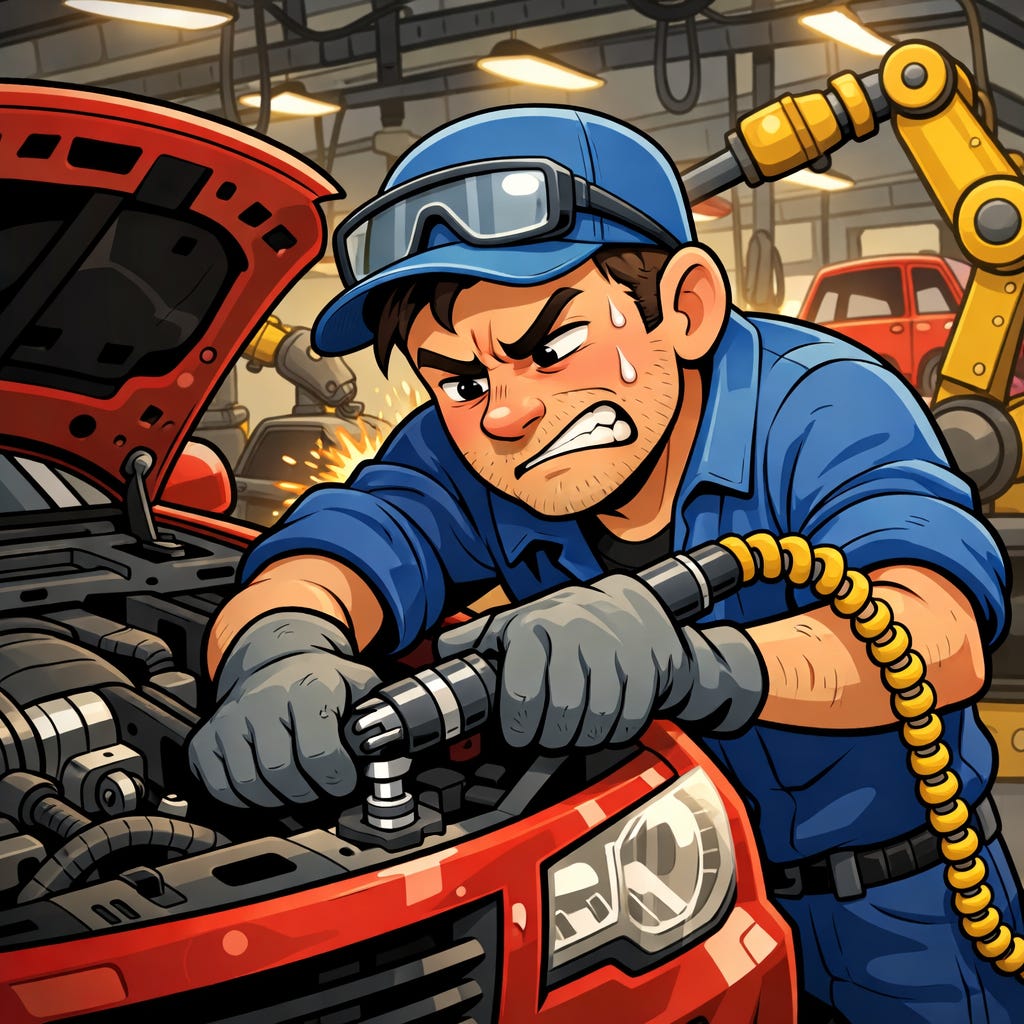
But to reap these rewards required us to fundamentally make the job of automobile assembly much less attractive… in fact, much more painful. Instead of being an expert in building handcrafted motorcoaches, you were Tightener of Bolt 948™. You couldn’t decide anything about your job because, let’s face it, there’s only one way to tighten bolt 948. You couldn’t even really feel the mastery of being great at your job because anyone could tighten your bolt equally well given one day’s practice. And it’s hard to talk about purpose when you do a robotic job requiring no expertise, a job for which anybody could be your replacement.
For the greater good of humanity — or perhaps that’s too generous a way to put it — for the increased collective ability for us to purchase far more for far cheaper, our society concentrates the pain of work into a subset of jobs. And even within those jobs, we concentrate the pain of their worst parts. Whereas the master automobile craftsman used to tighten bolt 948 as part of his overall job, it at least wasn’t a nonstop recurring theme of decades of his life. With the assembly line, bolt 948-type jobs have now become, in many industries, the only jobs available.
The joy of the many now requires focusing the pain on the few. A cynic might even say the joy of the many requires focusing the pain on the many — that we’ve essentially shuffled deck chairs on the Titanic, refactoring all our jobs so we each hold jobs concentrating pain in the name of efficiency.
How Bad Is It?
The underbelly of employment is so well hidden from view that we might not regularly appreciate just how bad some jobs are.
Take meatpacking. Upton Sinclair exposed the nightmare of this work in The Jungle back in 1906, yet these jobs remain horrendous in order to supply us with all the cheap meats we’ve become accustomed to, especially in the US. Workers in “animal slaughtering and processing” experience serious injury and illness rates nearly triple the private-industry average, according to the BLS. In fact, traumatic injuries happen to ~22.7 per 100 full-time workers per year in meatpacking plants.
Or take content moderation on social media platforms. In just three months in 2022, Facebook actioned 20,400,000 pieces of child sexual exploitation content. This content is, unfortunately as of this writing, still primarily adjudicated by human content moderators and reviewers, 93% of whom report moderate or severe levels of ongoing psychological distress. Can you imagine a full-time job where you looked at horrific images and videos all day?
The concentration of this pain is what allows the rest of us to view mostly-unoffensive social media feeds and eat surprisingly-affordable-for-all-it-entails meat. Our enjoyment of the world is contingent on a subset of us doing very distasteful, often traumatic, jobs.
Fireside True Story Time™: The worst job I ever personally held was being paid below minimum wage at a Subway sandwich shop. And even then, the worst thing I could say is that I didn’t eat at Subway for seven years after that. There are some things you just can’t unsee.
But I did however seriously consider two other jobs I ended up not taking, both in college. One was commercial fish processing in Alaska. It paid super well — in fact, around three times other jobs for college students. The gimmick, however, is you’d only be paid if you stayed through the entire summer. What most students didn’t know is that over half the people taking the jobs hate it so much that they quit way before the end of summer, forsaking all compensation.
The other was a really easy night shift job at a local garbage incineration plant, where you only had to collect a bucket of ash from the incinerator once an hour for the whole night. The rest of the time, you were welcome to relax, read a book, or whatever. The only catch was that the ash was known to be carcinogenic, and you had to sign a 5-page waiver complete with all-caps bolded words informing you of all the risks.
Is There a Problem?
If you’re a tech worker, it’s better than even odds you’re ultra-libertarian and don’t view much of a problem with any of this. After all, don’t these jobs compensate accordingly? Aren’t people working on oil rigs and in semi-abandoned fracking towns because of the sweet, sweet cash? Don’t free markets basically match people Pareto-optimally with the types of jobs they’re willing to do in order to afford the lifestyles they want?
Ignoring whether labor markets are truly well-functioning free markets, and whether the average small-town American actually has a true spectrum of employment choices, there are also self-serving reasons to be concerned about the concentration of employment pain.
For one, hyper-concentration of distasteful work dissociates us from pain we might otherwise be motivated to fix. One of the best ways to get engineers to build more reliable services is to make them responsible for live-site uptime. At OpenAI, I was responsible for the file service backend which undergirded all files stored by ChatGPT — all generated images, all uploaded PDFs, etc. When I first became responsible for that service, I used to get woken up 2-4 times a night with alarms about its various failures. You can bet I was highly motived to fix those issues ASAP if not just to sleep better. I would have felt nowhere near the same urgency to reduce that pain if I didn’t experience it myself.
Outsourcing call centers does the same thing to engineering teams. If you fielded customer calls a few times a month, you’d probably be much more motivated to fix customer problems systemically, durably, instead of whack-a-moling each individual customer report (or worse yet, ignoring them).
The concentration of pain around a subset of jobs is not only injurious to people desperate enough to take those jobs, but also reduces society’s overall motivation to eliminate or at least reduce that form of suffering.
What’s the Alternative?
Here’s where I’ll admit it’s far easier to call out a problem than to propose a credible, practicable solution.
Am I willing to pay more for meat without complaining all the time? No.
Would I like to help with content moderation on social media? No.
Do I want to frack myself? Not unless you’re talking in the Battlestar Galactica sense, in which case I’d find it amusing for a day to liberally use that thinly-veiled, censor-friendly word. But no. I do not want to frack my own oil.
Here are two examples where things have not regressed into a concentration of pain on the few, and a hollowing out of autonomy, mastery, and purpose:
Robert Loydell, at Aston Martin Works, continues to craft replacement auto body parts by hand. You can feel the sense of purpose this job exudes. It’s easy to believe the autonomy and mastery of this craft is hugely rewarding.
Hermès, maker of iconic items like the Birkin bag, has found it so hard to hire skilled craftspeople that they hire people without handbag experience and teach them, over a two year period, how to work leather and sew bags. In fact, you’re not even allowed to touch your first Hermès bag until after your second year of employment, such is the training.
The problem with this picture of employment utopia, of course, should be apparent in its price tag. There’s a reason the Aston Martin Valkyrie costs $4M and a non-“entry-level” Birkin bag costs $30k.
This idyll of people lovingly expressing their skilled creativity through masterful hand-crafting is only possible if we were all landed aristocrats. These types of jobs are essentially patronages, where the king tosses you a bag of gold nuggets to take four years to create for him A Broadsword Unlike Any The World Has Ever Seen™.
Perhaps I need to want less. Perhaps I need to be willing to pay more. Perhaps I need to take more jobs which are difficult, dangerous, or distasteful.
Or perhaps the genie is out of the bottle. We’ve discovered what amazing lives we could live if we concentrate the pain into a subset of jobs, and now we’re addicted.
One of my most frequently-spoken phrases in my 26 yr tech career: a system will never self-correct unless the person responsible for the pain experiences said pain.
The ultimate goal is to make the problem disappear (e.g. direct deposit, not an ATM on every corner).
This article is giving me very "The Ones Who Walk Away from Omelas" vibes (https://en.wikipedia.org/wiki/The_Ones_Who_Walk_Away_from_Omelas). It's an old meme, but it checks out. Has humanity always been doomed to get here?