
Form Line! Form Line!
The Zen of independent vs. serpentine lines and their surprising psychological side effects.

If you’re American, you no doubt are all too familiar with standard US supermarket queues where each cashier has a little line forming behind them. You’re also likely familiar with the stress accompanying line selection decisions as you eyeball not only the number of customers in each line but also the number of items in each customer’s shopping cart. You then bet on one line and commit.
At which point, inevitably, the person in front of you asks for a price check requiring store-wide announcements and the collaboration of multiple workers. When said item is finally priced accurately, the customer in front reveals he wants to write a check as payment. “Let me see your driver’s license.” “Who do I make the check out to? What’s today’s date?”
This is how America runs nearly every line, whether you’re waiting outside a concert at a row of Honey Buckets, paying to exit an airport parking garage, or crossing the border into Canada. The onus is always on you to pick the right line, to bet the right horse. Then to suffer regret as you watch other customers who arrived way after you blast past your dud of a line.
It doesn’t have to be this way.
Serpentine Lines to the Rescue
If you’ve ever checked out at an REI or a Fry’s, you’ll be familiar with “serpentine lines” or “single unified queues,” what academia calls M/M/c queues, where a single line is served by multiple servers. These designs completely eliminate the per-customer variance that comes from betting the wrong horse. They eliminate the stress of picking the right line, judging various cashiers’ apparent efficiency, gauging each customer’s likely payment speed.
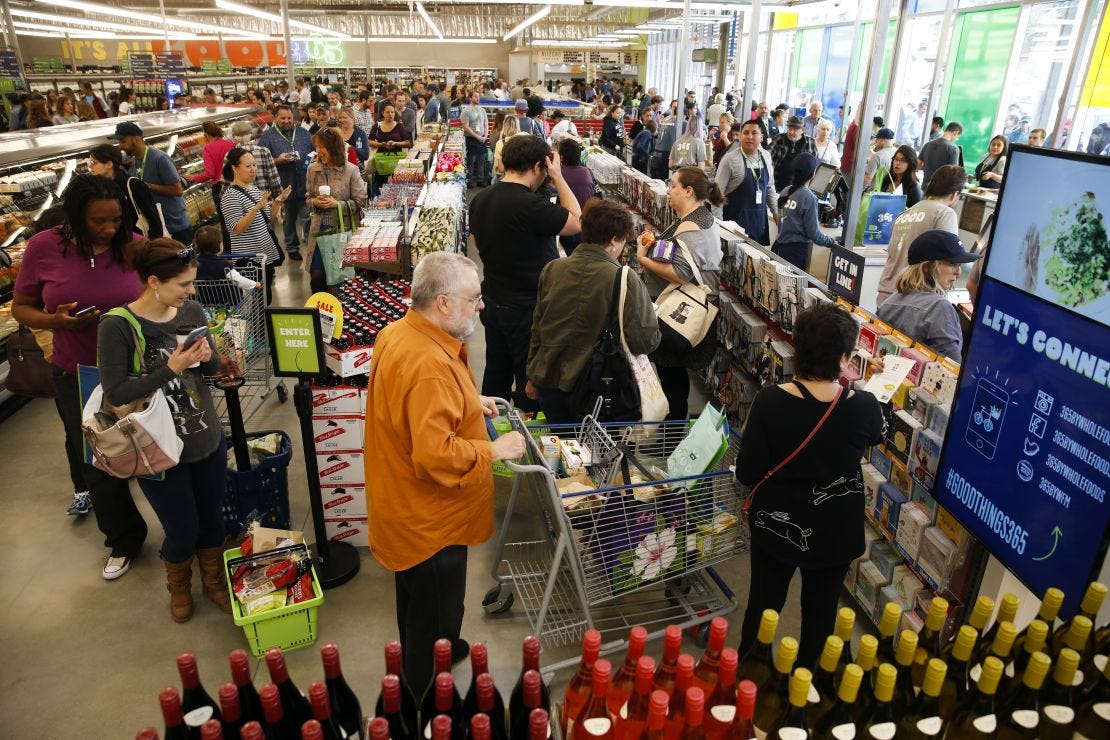
Assuming each customer occupies around the same square footage, serpentine lines don’t require any more space than independent lines, making them strictly superior. From gilgoomesh on Reddit:
In queueing theory… [serpentine lines are] the most efficient (highest server utilization) and the most equitable (consistent wait time) way to handle a queue under almost all circumstances. It is efficient because:
You don't have servers being idle because their queue is empty even though others are full.
You don't have stalls in service due to a single customer being slow.
All customers wait approximately the same time.
From operations research, consolidating even five queues into one with five servers can drop average wait times from 27 minutes to 5 minutes. Or consider this study of retail queuing in Tamil Nadu where wait times were reduced up to 4x. The wins are glorious.
Yet we don’t see serpentine queues in the US except for a handful of situations.
In Defense of Slow
Since throwing rocks often seems an indicator of erudition, I’ll save the naysayers the trouble of commenting by outlining drawbacks of serpentine queues.
First, there’s the same pragmatic blocker to US adoption of roundabouts: general populace confusion around how to participate in serpentine queues. Inevitably, the same guy who’s shocked — shocked — upon arriving at the head of the TSA line to learn he needs to present identification arrives at the head of your nice serpentine queue completely lost as to his next action.
Interestingly, there are at least two negative psychologic effects of serpentine queues:
People think longer lines = longer waits. Many people do not see the obvious efficiency of serpentine queues and will instead lament “such long lines at Manhattan’s Whole Foods.”
Servers operate more quickly with independent queues for reasons unclear, but one conjecture is they feel a stronger sense of personal ownership and accountability (i.e. it’s obvious to their boss if their queue is always backed up). This has been shown not only in grocery environments, but even in emergency departments where doctors act more quickly when serving independent queues.
So serpentine queues may not be as slam-dunk as they seem at first blush.
What To Optimize For
I’m skeptical of the few studies showing counterintuitive results primarily because the stronger a consensus between both theory and practice, the more the incentive for budding young PhD candidates to p-hack a contrary instance for their thesis.
Even if you allowed for exceptional cases where independent queues may, on average, be faster, I’d still push for serpentine queues as the best approach because I ultimately prize fairness even above efficiency. I hate the stress of trying to find the right line. I hate even more the realization I’ve picked the wrong line. I’d much rather all the customers have identical wait times and that no customer be subject to an unusually terrible outcome due to no fault of their own.
Perhaps if you’re the type of person whose first reaction is resistance to anything smelling remotely of change, I’d posit a compromise position we can likely both agree on: in some passport checkpoints in the world, queues have two servers per line — i.e. all lines terminate with two servers, and you go to whichever of the two servers is free by the time you’re at the front of the line. This change, in academic parlance, is going from M/M/1 to M/M/2, which in simulations can be many times faster (and here). For those resistant to change, I suspect moving to M/M/2 wouldn’t violate their need for stability while the rest of us could benefit from significantly higher happiness.
If you have any influence at all over customer facing queues, please help improve the world by lobbying for unified lines… or at least for M/M/2 lines. I thank you in advance.
Here in Italy, I see serpentine queues in both clothing and tech shops, but they require a large surface area. I think that applying this method to a grocery shop might fail for two reasons:
1) The psychological drawback. The customer wants to come inside, pick what they want, and leave. If they see one massive line or have to walk all the way across the store to join it, they might just leave. In tech and clothing shops, since customers spend more time browsing, they perceive the wait differently compared to a quick grocery run.
2) Space constraints. Shopping carts require a much larger turning radius, making the serpentine layout spatially expensive. This creates a high opportunity cost: that space could be used for products instead of empty lanes. Especially here in Italy, where stores are often smaller to fit into cities, we simply wouldn't have the room.
entirely agree. Larry David's also for the cause https://www.youtube.com/watch?v=M2CFFULmONk