
Lightning Crashes
Hits are random walks, and there's plenty of evidence to prove it.

What do the following have in common?
If you’re at all familiar with games, books, songs, or toys, you’ll recognize all of these. The songs in the list make the their commonality most obvious: these are all one-hit wonders where their creators weren’t able to create another noteworthy hit. [1]
The question isn’t whether it’s happened. It’s why it happened.
A Golden Lexus
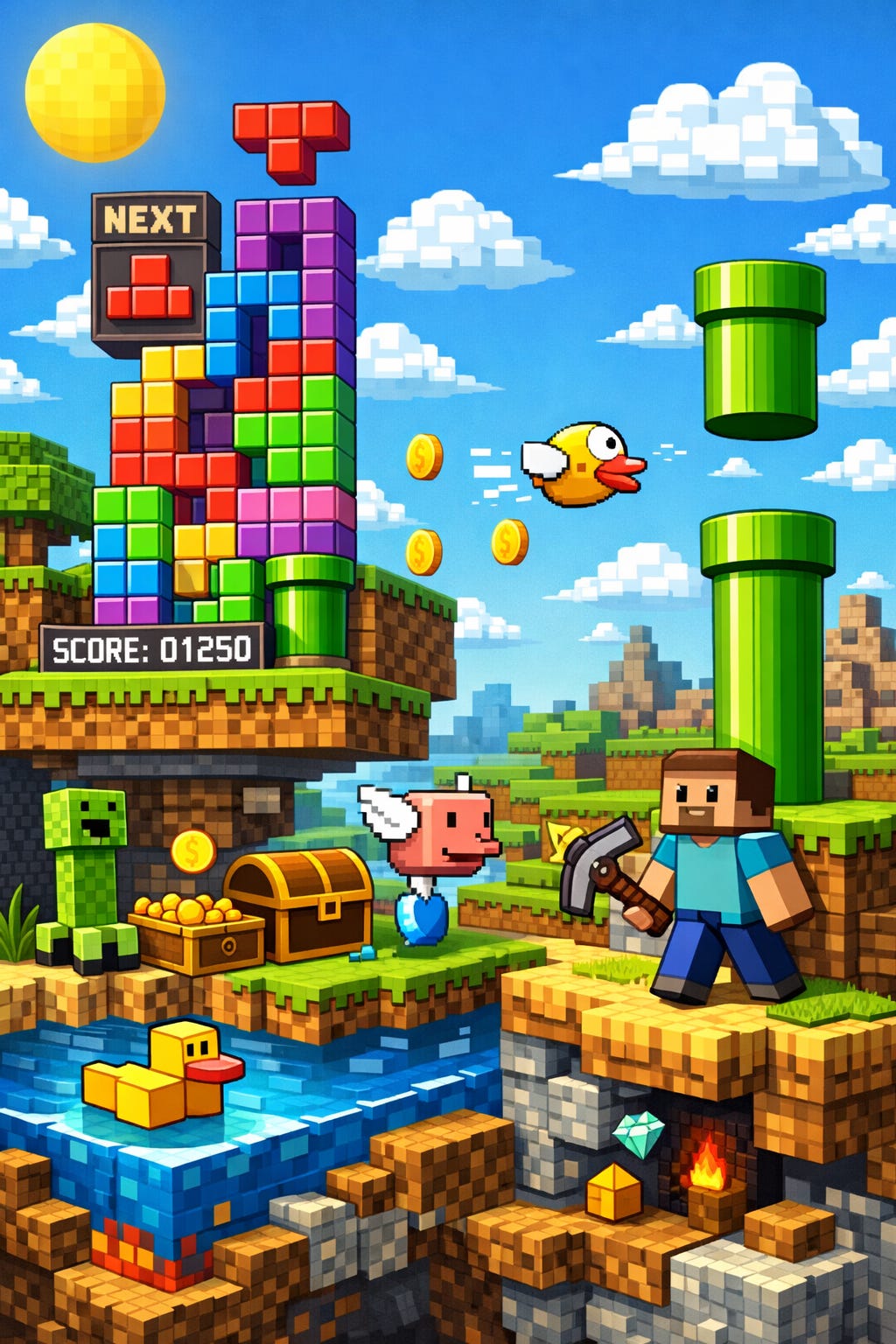
I overlapped many years at Microsoft with Alexey Pajitnov, creator of Tetris. Not that anyone had told me, though. It was more because I constantly saw a gold Lexus with the license plate TETRIS and looked it up myself.
Tetris is the best-selling video game of all time by a huge margin: 520 million copies vs. Minecraft’s 350 million.
But why was Pajitnov driving around Microsoft’s campus all the time?
Turns out he spent nearly 10 years at Microsoft trying to create a second hit game. The closest he came was Hexic HD, with total sales of 75,000 — that’s four orders of magnitude less than Tetris. That’s the same scale difference between Disney World edge-to-edge and the diameter of our planet.
Minecraft’s Markus Persson spent many years working on a much-anticipated sequel, complete with hype quite possibly exceeding the frothing-at-the-mouth anticipation of Daikatana, only to announce it’ll never be released.
Anyone remember Tickle Me Ernie?
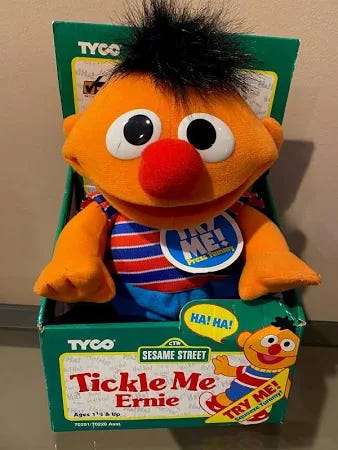
The point isn’t that these creators made their one hit and retired to Borneo. Each of these megahit creators continued to release new things over years and decades, none of which come close to the success of their One True Thing (Carl Franklin, also never another successful film).
The Misattribution of Lauryn Hill
She never said, "I would rather my children starve than have a white person buy my album," but that rumor spread like wildfire in the 90’s because it played to so many stereotypes and fears. (But interestingly, Eric Clapton did famously warn an audience during a concert to block the UK from becoming “a black colony,” ending his declaration with repeated shouts of “Keep Britain White!”).
I digress. But only a little.
The reason many people remember the never-been-said quote misattributed to Lauryn Hill, but not the many-times-shouted racial slurs and slogans of Eric Clapton, is because the former appeals to so many stereotypes. Black enclaves. Welfare queens. While the latter is so hard to believe coming from the same mouth accompanying gentle guitar strumming to Tears In Heaven on MTV Unplugged.
When someone creates Tetris, they want to believe — actually, we also want to believe — they have genius. How could a person write Infinite Jest or the Pulitzer-winning Pilgrim at Tinker Creek and not have bottled lightning they can repeatedly release into the world?
But objectively, empirically, they can’t. They don’t. There is no magic bottle of sparkles.
We often misattribute people’s success to what we assume are innate characteristics, like creative genius, as opposed to events outside their control. This form of misattribution is a sort of correspondence bias.
I submit, instead, that many — in fact, some might argue most — megahits are completely unpredictable phenomenon which can’t be repeated. Things take off for reasons unclear, reasons which, if marketers and businesspeople could accurately pin down, would be repeated over and over if not merely for all the sweet money that would ensue.
It’s clear from history, and many creators’ intentions over decades of effort, this is not the case. Megahits are random walks.
I’ll Buy That for a Dollar!
I’ve got a great pitch for you to invest in.
I’m going to start a website featuring descriptions of all the world’s most interesting topics. It’ll be like encyclopedias of the past, except I plan to make it 500x larger than the world’s largest. Oh, and before I forget: I don’t plan to author any of it. I’m going to ask people to volunteer to write 100% of it with no compensation. And it’ll be edited and curated by random people I haven’t met yet.
Want to write me a check? What — not interested in such a great pitch?
Ok, second idea. I’m going to release a mobile messaging app several years after many other messaging apps already exist. Oh, and before I forget: it’s going to have far less features than most existing ones already on the market. Want to write me a check?
Last idea: random people paying strangers to stay in their homes, sight unseen. Time to invest?
Everyone thinks Wikipedia’s, WhatsApp’s, and Airbnb’s successes are foregone conclusions. But no one — at least anyone we respect — would have invested in these pitches a priori. Their successes only seem guaranteed and obvious in hindsight.
We know megahits can’t be intentionally produced because:
There are so many examples of smart investors kicking themselves because they were pitched ideas like Uber and chose not to invest because they sounded outlandish.
These ideas’ creators have tried for decades to release subsequent hits to no avail.
Even if all ideas’ successes were completely random, and fads were based on no causes at all, we’d expect an uneven distribution of outcomes, some of which must entail dramatically-outsized results.
Name Your Dog Pickles
I’m not saying there aren’t geniuses. Many people create hit after hit.
I’m not saying the creators I’ve listed above aren’t brilliant. They are. People don’t wade through 1088-page novels of pure crap. But there’s a vast gulf between “I’ve got a great idea” and “My great idea is going to make millions.” The former may well be true. The latter is empirically impossible to ensure.
Fireside True Story™ Time: 25 years ago, a friend took me to a small badminton-sized court in Redmond, WA with a whiffle ball and two wooden paddles. He explained a game named after a dog (edit: incorrectly, it turns out; the game was named after the “pickle boat” in crew; the dog came after). The court was never in use, though right next to a highly-trafficked thoroughfare, because absolutely no one was interested in the game in its first ~40 years of existence. The game was amusing but not astoundingly addictive.
I now can’t reserve a pickleball court to save my life, even with two weeks’ worth of advance notice.
Good ideas are indeed a dime a dozen. Making an idea a huge international success is something no one knows how to do intentionally.
You know what else got little attention its first ~40 years? Kate Bush’s Running Up That Hill hit #1 a full 37 years after its release. Absolutely no one could have anticipated how Stranger Things turned its dormancy upside down.
Forgive yourself when something you know is brilliant has zero takers. Your idea may well be genius. And it’s worth pursuing.
Lightning doesn’t come in a bottle you can open and unleash on the world at will. Lightning crashes.
[1] Geeks of all sorts will come out of the woodwork and start spouting songs like Sevilla tiene un color especial. I’d say you’re stubbornly using esoterica to resist a point. As Darth Vader would say, “Search your feelings; you know it to be true.”
Luck, skill, & timing all have to come together for a big hit. Skill you can collect. Timing is a matter of waiting & then not waiting. Luck is, well, luck.
Theme of “Fooled by randomness”.