
Sometimes a Thing Is Just Expensive
You often get what you pay for. But you sometimes pay more for little gain.

Around my late 30’s, I felt I had made it in life. I had a supportive wife and two wonderful kids. I was leading the Facebook London engineering office as its site director, making more every year than I had across my entire 12 years at Microsoft. I had succeeded beyond anything I reasonably expected in my 20’s.
The world was my oyster.† It felt a good time to buy something representing the fact I had arrived. It was time to buy a pen.
And I don’t mean a fountain pen, or even the Sylvester Stallone Chaos, which I’m told had gem-encrusted versions selling for $50k each. I was under no illusion that those pens could possibly justify their cost. And I always knew fountain pens were more trouble than they’re worth, largely a nod to robber barons and the Gilded Age, a sort of declaration your name was probably “William Wentworth IV” of the landed gentry.
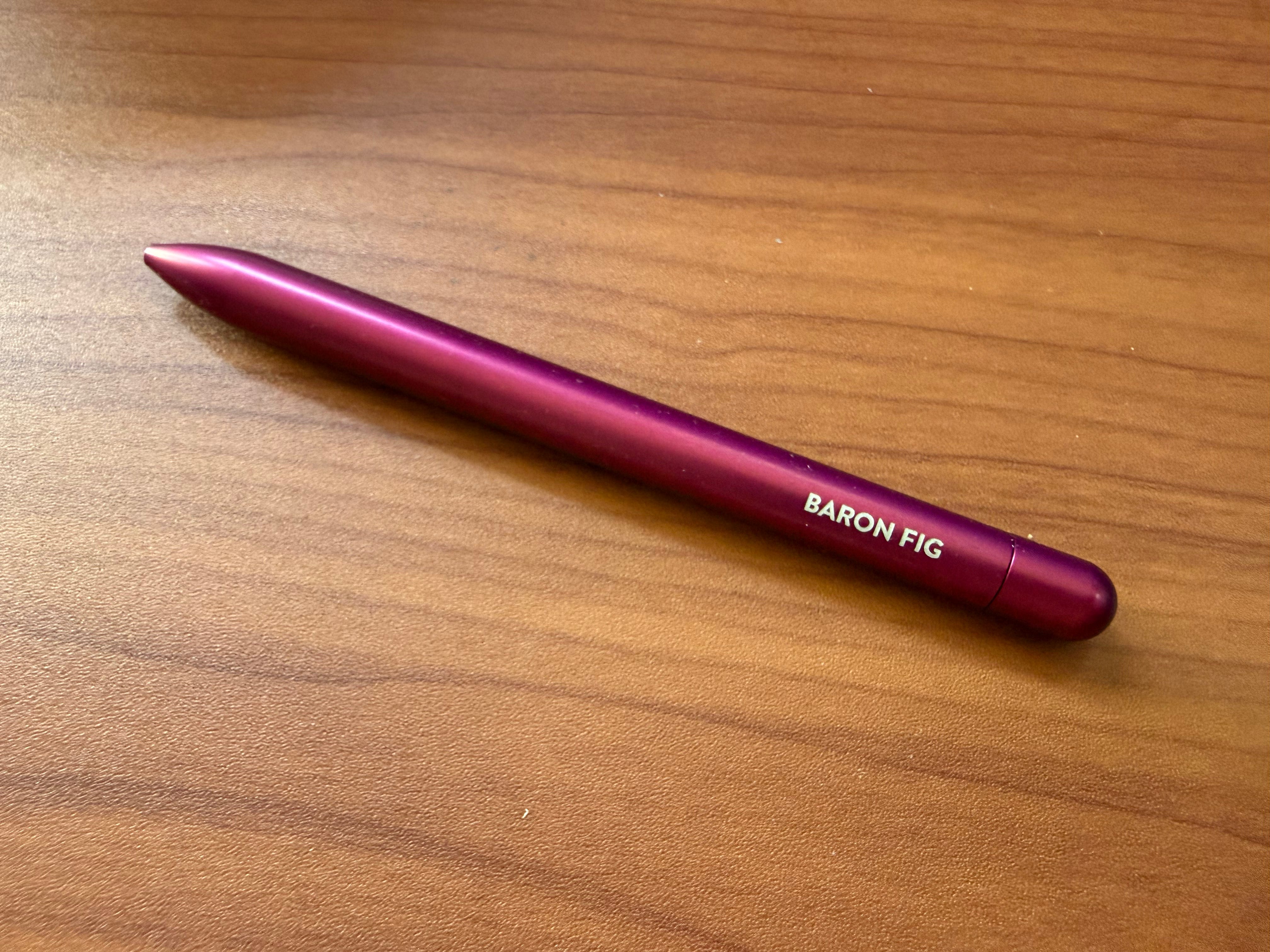
I wanted the best pen you could buy if money was no object. So I relied on New York Magazine’s review of 100 best pens, and bought its #1 pick: the Baron Fig. Machined out of block aluminum, weighted a certain way, blah blah blah. Ignoring price, one $55 pen seemed a reasonable nod to the fact my career was going well. A worthwhile indulgence, a bit of a splurge.
Never mind I rarely wrote anything. In fact, I’ve written so little in the past two decades that my handwriting now looks like a child’s, and each time I write feels like the start of physical therapy, with my inept fingers shakily forming letters from days of yore. But I wanted The Best Pen because I Had Made It.
I unboxed my newly arrived pen with a giddy anticipation and a warm satisfaction that, yes, all the years of hard work were worth it. Now I would write like few have written before, luxuriating in a joy The New Yorker Magazine assured me topped 99 alternatives.
This glow faded within a month, by which point I was rarely, if ever, using the pen. Turns out a heavy, perfectly cylindrical pen is almost never what you want, unless you only ever work on professionally-leveled tabletops. The weight, which reviewers praise, is a drawback — in fact, the same drawback as the heavy smooth-metal chopsticks Koreans often use, which constantly slip out of my unpracticed hands onto whatever plate I’m pointing them towards. Twist-actuating a pen always requires two hands, unlike click-activated pens. The idea that I owned An Expensive Pen™ was quickly overtaken by the sheepish admission that about the only thing the Baron Fig was good for was the meager satisfaction I could afford its $55 price tag.
The joke was on me.
Know What You’re Paying For
Not everything works this way, of course. Oftentimes you get what you pay for. Then again, it’s important to be clear about exactly what you’re paying for.
Some things are positional goods, whose value derives purely from the fact only a limited number of people can have them. In the UK, a funny-to-an-American positional good is the desire to have the equivalent of low-number plates. Vanity plates with only two alphanumerics are especially rare and thus coveted almost exclusively for their exclusivity. (Though the funniest case of this I observed in London was a house with two Aston Martins out front: “2B” and “NOT 2B,” cars which could only ever be legitimately parked relative to each other).
Then there are Veblen goods, things whose values increase precisely because of the amount paid. Two examples:
Mooncakes are often a formal gift amongst the Chinese during the Mid-Autumn Festival. Because of their value as gifts, there are a variety of ridiculously priced mooncakes in superb packaging where the entire point of those mooncakes is to convey to the recipient just how much you’re willing to spend on them. Their expense is the point.
In a more humorous vein, Microsoft SQL Server 6.x used to cost several hundred dollars a pop, when Oracle already cost 5-digit sums. In a brilliant move, SQL Server 7 was priced nearly two orders of magnitude more, at which point customers took the product much more seriously instead of viewing it as a toy database. The surprise wasn’t that SQL Server 7 made more revenue; the hilarity was that the much more expensive version sold more total units. The much higher pricing itself did most of the marketing.
Yet sometimes you’re truly paying more for quality. Or perhaps the thing you’re buying is an experience, something memorable to share amongst people you love. An example is when our family bought, for the only time in our lives, Suites tickets on Singapore Airlines. This was a huge splurge, something not to be repeated — but sharing this experience as a family was a worthwhile one-time expense. What we were buying was not the suite itself, which, judged on its own merits (e.g. by the square footage of plane it was taking up or the opportunity cost of other tickets to be sold in the same space), likely doesn’t pencil. What we were buying was the memory of living like sultans, if only for a day.
Oftentimes, Cheaper Is Better
I’m a Costco shopper, so you probably could guess my opinion on price vs. value. But I’ll ground it with some examples.
Another thing I bought for myself which I now feel foolish for is a Toto Washlet. Google employees rave about how they’d never poop anywhere else. Oh, the luxury. Oh, the amazing feelings of cleanliness. So many of my techie friends swore by their Totos that I ended up buying one myself for $2,000.
As with the Baron Fig, I had high expectations of a scatological life revolutionized. I don’t know if I’ve ever been as excited to poop as on the debut day of the Toto Washlet, which I even had to rewire my bathroom for in order to operate.
Over the past few years, it has malfunctioned many times. I’ve replaced the entire unit once, and refuse to a second time. It makes noises at night while you’re sleeping, like a dog who loudly yawns awake to remind you he’s restless. It causes even more cleaning headaches because of — putting it delicately — collateral splash damage.
Turns out flushable wipes have none of the drawbacks and most of the advantages, coming perhaps 100x cheaper. I had not known this when starting this whole Washlet adventure, but suffice it to say that I now Subscribe and Save™ on Amazon.
Or take Lamborghinis. I owned this Diablo SV many years ago, repo’d in Las Vegas and sold to me for less than the price of a Porsche:
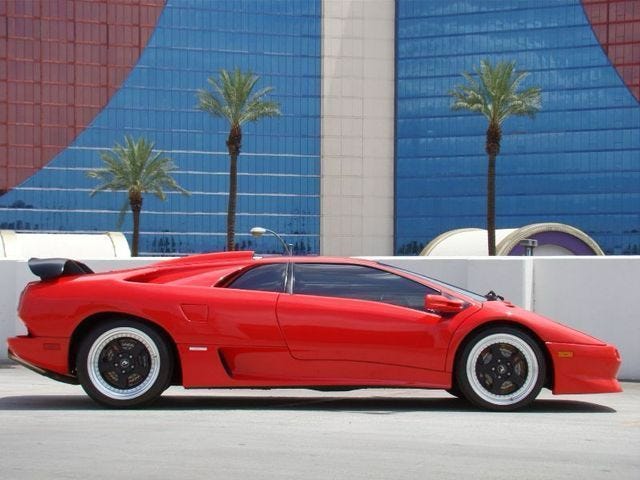
Changing the clutch was nothing like a Honda, requiring the wholesale removal of its engine and transmission in order to replace the $2,000 clutch yourself (photos here). The Diablo came with a switch you had to actuate whenever parking it for more than a few days because they were manufactured with so many electrical leaks that the makers simply gave buyers the ability to disconnect the entire electrical system, passing this ridiculous responsibility to owners.
I’ve since discovered you’d much rather drive a Lotus Exige Cup R, at perhaps a quarter the price, at a place like Spa Francorchamps. It’s lighter and has better road feel with much cheaper consumables. Repairs are easy. It’s better in almost every way if you’re interested in racing. But the Lambo is better if you’ve bought BTC and want the world to know about your diamond hands.
It comes down to purpose and your ability to use things. I once saw someone at Sonoma Raceway driving a stock Honda S2000, lapping people in much more expensive Porsches and Aston Martins.
Oftentimes cheaper really can be better. You need to know why you’re actually buying something.
Asymptotic Limits of Performance
“A billionaire can’t buy a better Coca-Cola than the bum on the corner.”
— Warren Buffett
Similarly, people have expressed ideas like the fact that Bill Gates can’t buy a better iPhone than you can. It might have been John Steinbeck who said something to the effect that “no man can eat more than two eggs for breakfast.”
I’m not saying expensive things are crap, or that they’re all a scam. What I’m suggesting is to:
Know why you’re buying what you’re buying
Decouple price paid from value received
Realize there’s no end to the ability of positional and Veblen goods to separate you from your money
After several false starts, my favorite pen is actually the Pilot G2, which writes easily and smoothly with a gel that doesn’t bleed when wet. It click-retracts and doesn’t require capping / uncapping. It doesn’t roll on tables. And it’s $1.91 on Amazon.
Not everything turns out this way, of course. But far more things do than I ever thought did whilst I was less well off.
“I think everybody should get rich and famous and do everything they ever dreamed of so they can see that it’s not the answer.”
— Jim Carrey
Fireside True Story™ Time: I wanted so badly for the Toto Washlet to work out, especially since so many friends had effusively lauded its revolutionary effect on their lives. In truth, I also likely suffered a sunk cost mindset and motivated reasoning, where I wanted my $2,000 to not feel wasted as an embarrassing mistake I sit on every day.
Much research included things like whether the Washlet itself was sufficient for cleanliness, with various online forums saying things like, “Some people sweep then mop, others mop then sweep.” And many, many hours were poured into DIY repairs on various malfunctions, all of which seemed to kick in the week after its warranty expired.
In the end, despite the Toto Washlet essentially being broken at this point, I keep it resolutely in my main bathroom as a daily reminder of my folly, an enjoinder to myself to carefully consider why I’m buying some expensive thing and whether, in some cases, I could be paying for misery and inconvenience instead.
† This, as with many other phrases (and words like “manager”), comes from Shakespeare. In The Merry Wives of Windsor: “Why then the world’s mine oyster, which I with sword will open.”
“what we were buying was the memory of living like sultans, if only for a day” is such a good distinction. some luxuries are worth it not because they’re efficient, but because they become part of the family mythology forever
thank you for a great engaging piece. And yes the pilot G2 is still one of my fav pen