
The Windowless School Movement
It's amazing how easily we embrace brutal ideas with little proof

I attended Eleanor Roosevelt High School (ERHS) in Greenbelt, Maryland, a school that — and this is not an exaggeration — did not have a single classroom with a window. I must here emphasize, despite your incredulity, that ERHS, the largest and top high school in Prince George’s County Maryland, literally did not have a single classroom where a student could see daylight.
Here’s photographic evidence:
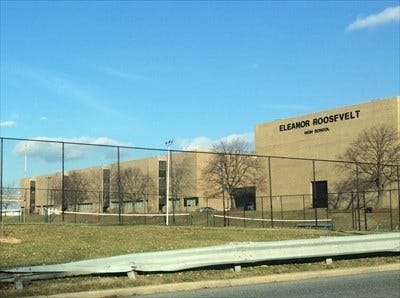
“Wait!” I hear you saying, “Aren’t those windows I see in dark brown vertical columns arrayed four times down the length of the school?” And you’d be right — those are indeed windows. But the few narrow columns of windows you see are only found in emergency fire escape stairwells leading out of the school, presumably for rescue staff to extract a few lucky students during infernos.
Can a school really insist that three thousand students don’t see the sun from 8:30 a.m. to 3:10 p.m. every weekday of the year?
Yes, yes it can. And it’s not alone.
Windowless Schools
ERHS was built during the tail end of the “windowless school” movement. (Yes, there was an entire movement!) Opening in 1976, ERHS caught the tail end of a movement which lasted from the 1950’s to the 1970’s. The lack of windows at ERHS, thought by students to be an unfortunate oddity, turns out to be by design. It was intentional.
Windowless schools became a thing in the second half of the 20th century because the prevailing theory, supported by a shocking paucity of evidence, was that windows created distractions which detract from learning efficacy. Never mind that the same theory was rarely applied to colleges, much less workplaces. People in the ‘50’s through the ‘70’s liked windows in their own workplaces (e.g. the concept of the corner window office remained an elite perk for careerists), but they knew — just knew — windows couldn’t possibly be good for students.
New Mexico was the trailblazer in windowless school maxxing, though it was soon outdone by California’s enthusiasm in constructing the most windowless schools in the nation. By 1966, over $100M of windowless schools had already been built, and there were still another 10+ years of construction to come. (That’s over $1B in today’s dollars.)
Another reason commonly cited during that period in defense of windowless schools was — wait for it — vandalism. That’s right. Having windows makes you susceptible for those same said windows to be broken by hooligans and pranksters. By the same reasoning, I’m mildly surprised exterior walls weren’t also eliminated, given their siren call to the likes of Banksy.
2 Brutal 2 Last
Thankfully after three decades of enthusiasm behind locking kids into windowless schools, even education architects began to rethink their theories. An entire generation raised in windowless schools did not outperform previous sun-exposed millennia of students. And that generation, once adults, started speaking out against the windowless movement much as I am today.
Perhaps most amusingly, Windex (that’s right — the window cleaning spray company) has an entire page devoted to these mistakes of yesteryear, featuring modern schools which have repented of their windowless ways.
More disturbingly, New Mexico, that bastion of windowless school “innovation,” continued to publish papers even as late as 1975 reassuring us that, despite many other studies showing the positive benefits of windows on both students and teachers alike, you can design studies where it’s still a toss-up of an open question. Never mind that New Mexico’s own state capitol features many (no doubt endlessly distracting) windows:
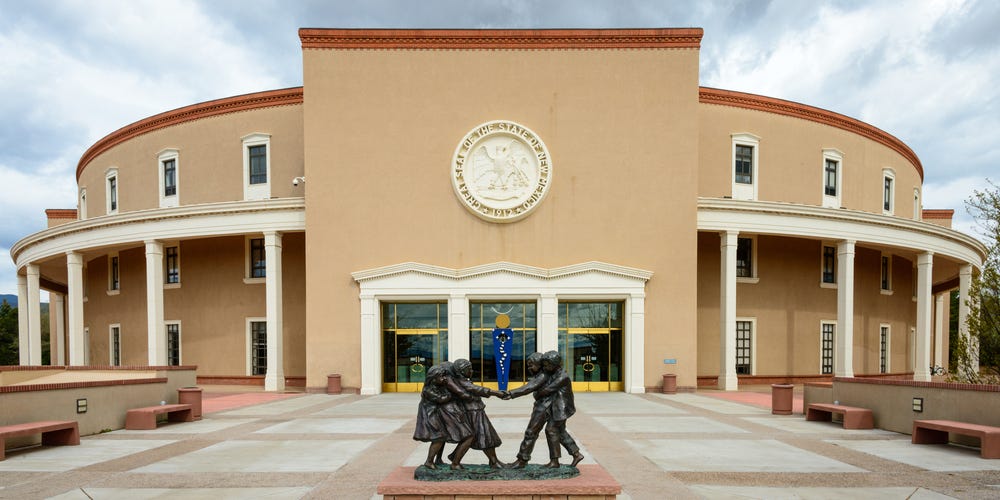
“What’s that?” you say. “Do mine eyes deceive me, or is that a statue of children, outside, exposed to the many distractions of daylight?” And you’d be right. The artist, Glenna Goodacre (yes, of Sacagawea dollar obverse fame), meant for it to evoke, amongst other things, openness.
ERHS Today
Despite all the depressing memories, there were silver linings to the Eleanor Roosevelt High School story even during my time (1990-94), one of which was the fact the school was woefully under-built for the 3000+ students it housed in the ‘90’s.
As a result, more than 20 portable classroom units (which we called “temps”) sit, pretty much permanently, throughout the parking lot like a Walmart full of RVs:
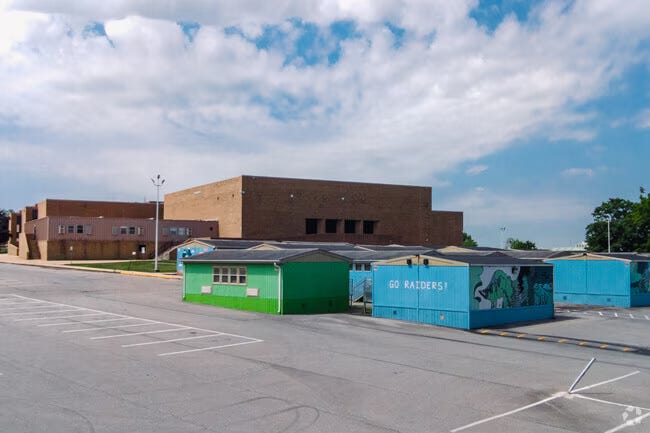
I couldn’t find a great photo, but it’s still clear the temps each had windows. Though back in the day, those temps were all uniformly beige like the color of all PCs in that pre-iMac era.
The main building of ERHS, fifty years in, remains windowless despite decades of research indicating it’s a bad idea. Yet it continues to be the top high school in PG County, leaving the open question of how very much better its students could have done over the past half century if it hadn’t bought into the trendy, misguided windowless movement of the mid 20th century.
It managed to produce Sergei Brin. Martin Lawrence, the comedian who one day drove up in a brand new Lexus to gift to a teacher who always supported his class-clowning days. And Mýa, the Grammy-winning R&B singer.
During my time, it also featured principal Gerald Boarman, who amongst other things was later accused of financial impropriety by the Washington Post based on unusual spending patterns benefiting general counsel Natasha Nazareth, who followed him from a school he led in North Carolina back to Bullis School in Maryland.
But never mind that. Far more important is the fact that you, too, can now own this amazing t-shirt designed by yours truly:

Buy yours today! Also available as mugs, mousepads, hats, aprons, and other configurations.
If your school had windows, you escaped decades of seriously misguided architecture. If you didn’t, my sincere hope is that college and adult life have allowed for windows, regardless of their supposed vandalism risk.
Fireside True Story™ Time: My graduation was the only year where the valedictorian’s speech was pre-screened by the principal and several students. Years later, a student told me this was instigated by our salutatorian, who felt similarly to McKayla Maroney for not having been valedictorian. He was concerned I was a Christian at the time, and wanted to make sure requisite censorship was applied.
Not having known he was the main reason for the pre-screening, I asked him in private what he’d recommend I do. With feigned conviction after hearing me read it, he said, “You should get to say whatever you want.”
So I did. The school was displeased to the point that my graduation was also the only year where they had the salutatorian do all the emceeing. Featuring him heavily was a way to distance the windowless school from what they feared would be my assured disaster of a speech. We didn’t know back then that Principal Boarman himself would cause much bigger scandals years later.
Though I no longer believe the same things I did as a teenager, I stand behind my right to say what I did, and am still convinced the school discriminated in their treatment of my graduation. I just wasn’t mature enough back then to stand up for myself.
Wow, wise beyond your years when you were a young adult!! Excellent speech, I hope it spoke to at least a few hearts :)
Beyond bizarre with the windowless schools! I can't think of any weird thing my school did, other than being really annoyed at our strict school uniform requirements. Hair had to be a "natural colour", either short enough above the face or tied back with a (black only!) hair tie. Oh the horrors of letting hair dangle!