
TV Reloaded
The rewatching of favorite TV shows often leads to liking them less.

[Special Surgical Edition: Today’s publication is out one day early because my gallbladder is getting removed tomorrow. 1.1cm polyp, I’m told, means it’s gotta go.]
[Warning: This essay contains spoilers for several TV shows. But the shows I discuss are all old, so I’m unlikely ruining anyone’s enjoyment.]
I’ve never liked a TV show more after rewatching it years later, though I’ve often had that experience when rereading a book or rewatching a movie. I’m not sure why this is.
For about a decade, I had been telling people my favorite show of all time was Breaking Bad. Recently, upon the tenth anniversary of my having first watched the series, I binged all five seasons over two weeks. I can now say definitively that it’s no longer my favorite show of all time, for sure, but it’s not because I found a new favorite in the intervening years. It’s because Breaking Bad fell significantly in my estimation after the second watching.
There are a few classes of changes which could account for the phenomenon whereby TV shows have never improved upon rewatching, while many get worse when revisited.
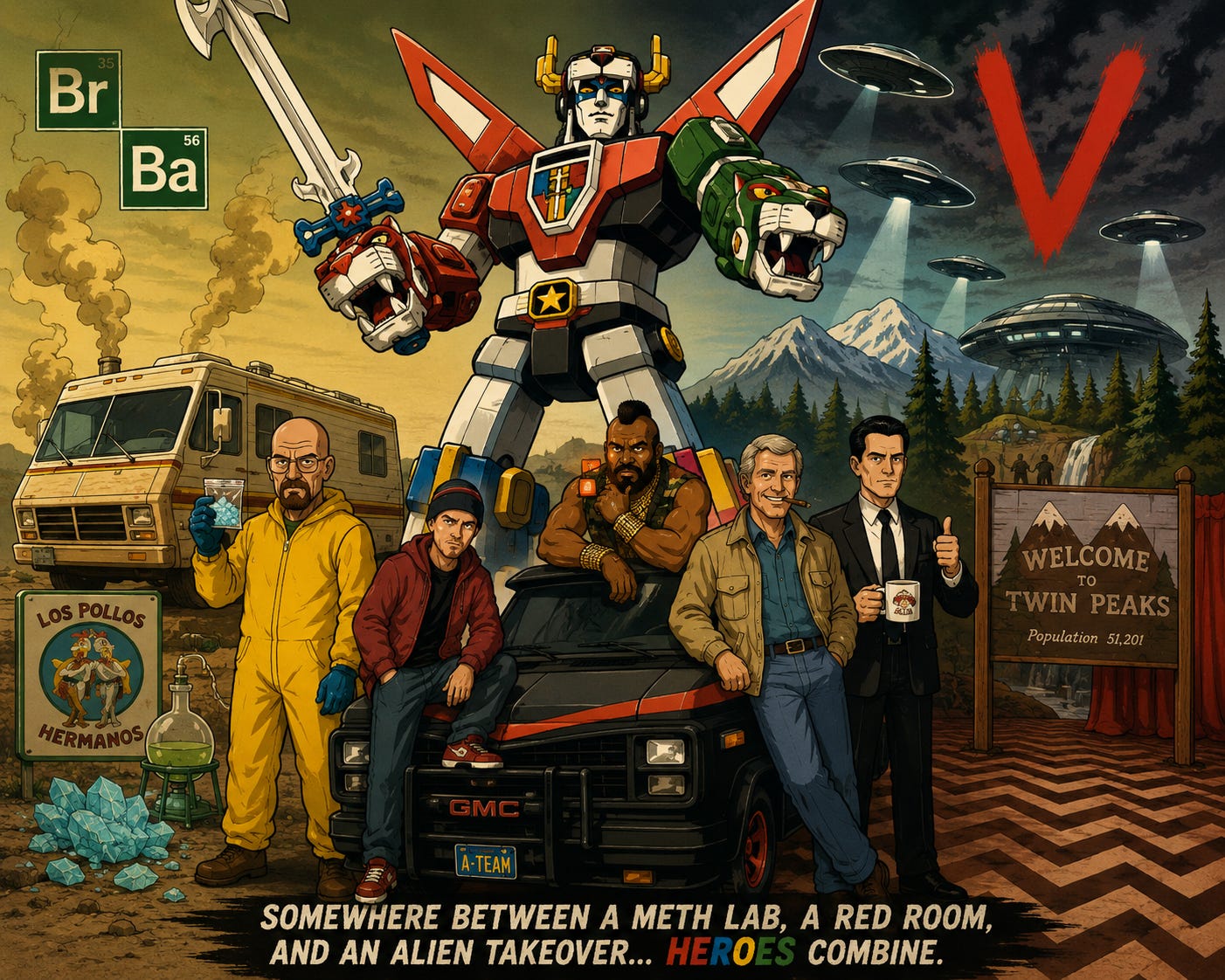
Perspectives Change
“No man steps into the same river twice — because it is not the same river, and he is not same man.”
— Heraclitus.
It’s one thing to like Voltron when you’re twelve. But nearly no one likes it when they’re 50, because their perspective changes. Every episode of Voltron starts with the heroes battling the villain as five separate lions. They always do terribly and are nearly overcome by the time they finally decide to join into Voltron (“I’ll form the head!”). The fight still doesn’t go too well, at which point they pull out the Mondo Sword™, which, without fail, always kills the enemy in one slash. Never mind why they don’t just always start the battle with that sword, given history and all.
A-Team falls into the same category for me:
They arrive into some new town where a local shop owner is being harassed by hooligans.
The owner herself, or perhaps her daughter, is attracted to Face.
Murdoch performs general shenanigans.
B.A. calls Murdoch a fool.
The team welds, screws, and duct tapes together some number of weapons and machines to counteract the hooligans.
They save the shop, and Hannibal says, “I love it when a plan comes together.”
I loved A-Team as a kid. But rewatching it as an adult is a huge mistake. Blues Clues revolutionized children’s television with the insight that very young children prefer the same exact episode airing five days a week. Anticipating what you know will happen is its own form of fun. It’s predictable and safe. You love reliving the feelings. This, it turns out, is part of what was great about Voltron and A-Team. Its predictability was a key part of its value proposition.
Our perspective also changes because life experiences help us identify more strongly with certain stories over time. For reasons unclear to me, my high school required us to read The Sun Also Rises, Hemingway’s story about a man’s struggle with alcohol addiction and impotence — two things that I had absolutely no understanding of as a 16 year old.
Given that, you’d think I’d identify more strongly with Walter White upon rewatching Breaking Bad this year: Walt turns 50 in the first episode, and I’ve just turned 50; my mom passed away last year from cancer, and Walt is diagnosed with cancer in the first episode. But despite my new perspective, I strangely didn’t find the show more compelling for reasons I’ll get into.
Expectations Change
I watched Rashomon and Seven Samurai, both legendary Kurosawa films, late in adulthood and found them completely unremarkable. I only learned later that this was because I’ve taken for granted several common occurrences in film which those movies invented:
Rashomon was the first time a movie showed the same story looking very different depending on whose perspective you’re showing.
Seven Samurai invented the thing where one enemy crests into view over a hill, followed shortly by hundreds of his compatriots cresting all at once.
Similarly, if you’ve ever rewatched the original Jurassic Park, you’ll likely feel unimpressed. Back in 1993, when seeing it for the first time in theaters, audiences positively lost their minds when the brontosauruses (or are they now apatosauruses?) first came into view in the grassy valley. People went nuts because they looked so real.
We laugh when we hear stories of people diving out of the way of trains driving straight towards the camera in black and white movies… but the locomotives really seemed that real to them. The original Jurassic Park dinosaurs inspired that same incredulous awe. However, when you now go back and watch that exact same scene which in 1993 caused you to nearly lose continence, you’ll find plenty of flaws in those dinosaurs. The lighting… the textures… it all looks as real as a black and white locomotive coming toward the screen looks threatening — which is to say, not at all.
Friends and I rewatched an episode of MacGyver about fifteen years ago after reminiscing about how great the show was in our childhood. Big mistake. Its production had such low standards that a car crashing into the living room window of a house was shown with the stuntman’s plywood launch ramp still visible in the final edit. V: The Original Miniseries has the same flaws. A show I loved as a kid now looks low budget and melodramatic.
Sometimes, a show is just relevant to its time period. I’d put Twin Peaks in that category: perfect for 1990, completely non-sequitur and inexplicable in 2026.
One last major shift in expectations is around the norms of storytelling and pacing. The Wire was a groundbreaking, magnificent show, loved by critics and fans alike. But anyone watching it for the first time in 2026 will likely need to amp the playback speed to 2x because shows like Breaking Bad have completely changed the pace at which we expect things to happen in TV dramas. Somewhere in Season 1 of The Wire, you’re likely to drop off entirely the way most people do when J. R. R. Tolkien goes into Yet Another Five Page Poem About Lothlorien. In fact, The Wire doesn’t even really take off as a story until Season 2.
Details Matter
Rereading a book and rewatching a movie both give opportunities for you to notice details you missed the first time. When you rewatch The Usual Suspects or Sixth Sense, you’ll likely notice far more details which increase your appreciation for their writers’ craft.
I’ve not found this same dynamic in rewatching TV shows, though, and I’m not sure why. You for sure notice more details. But seeing more details in television shows often leads to more disappointment, not more appreciation.
In my second watching of Breaking Bad, I noticed signs of Walt’s ego and his selfish behaviors very early in Season 1. Whereas my previous memory of the show was that Walt was good for a while and eventually became beat down by circumstances and corrupted by his work. With my rewatching, I now recognize Walt was bad from the very beginning, and thus felt a lot less sympathetic towards him because he committed so many selfish acts at the behest of his insatiable ego.
Whereas in rewatching shows like Twin Peaks, you end up noticing far more inconsistencies where the story doesn’t hold together, or where actors are shown in obviously different positions via the two cameras in a scene. Idle cycles of the mind, formerly spent on tracking the plot, can now roam the scene picking up all sorts of distracting, unhelpful details that were mistakes or omissions.
I still can’t explain why all of this is any different between TV shows, movies, and books. While I’ve often enjoyed rewatching movies and rereading books, I’ve never never had a better experience with a TV show the second time around.
Fireside True Story™ Time: Some movies based on books are great. But you should never read a book based on a movie.
I made the huge mistake of reading Robocop (the book). It was absolutely terrible. In fact, I’d posit there has never been a book that was as good as, or better than, the movie it was based on, though there are many examples going the opposite direction.
Going from a book to a movie is a process of distillation, whereas going from a movie to a book is an act of invention, the far more difficult task.
I’ll leave you with one last thought. It often pays to watch TV shows for the first time many years after they debut, for the same reason as reading older books: survivorship bias. There’s a reason we’re still talking about some books centuries after they were written. Star Trek and The Office were both much more popular in syndication than they ever were when new. And if you’re lucky, as with me watching The Sopranos a decade after it first aired, nobody will have inadvertently spoiled the ending.
I remember loving the Six Million Dollar Man as a kid. I tried rewatching what I remembered as my favorite episode as an adult. It was shockingly bad. On the same theme, I thought Castle Wolfenstein on the Apple ][ was the greatest game ever as a kid. I recently ran across a web-based emulator that allowed me to play it again. The memory of it was better than the actual game experience.
Isn’t it generally true that movies have higher quality writers and longer development times due to the economics?
Similarly, TV series, at least in the past, were designed to run for as long as possible, inevitably leading to poor storytelling. Like maybe in the 90s, Stranger Things would have gone on until everyone hated it even in the first watching.